Narita is not Tokyo's closest airport. It is forty-one kilometres from the city and sixty minutes on the Skyliner. It was built in 1978 over the objections of the farmers whose land it displaced, and those objections did not end when the airport opened. What Narita became despite this is the purest expression of the Japanese airport thesis: not the flashiest, not the closest, not the most efficient by the numbers, but the one that treats the long connection as a deliberately engineered experience rather than a problem to be endured.
The ground crew member in white gloves who watches your aircraft push back holds her bow until the plane turns toward the runway. She does this for every departure. Japan keeps its airports as the first and last act of a longer ceremony. At Narita, that ceremony has been running for nearly fifty years.
The airport handles roughly forty million passengers across three terminals. Terminal 1 is the international flagship. Star Alliance on the north wing, SkyTeam on the south. Terminal 2 serves oneworld and low-cost carriers. Terminal 3 is a dedicated LCC terminal. Each has a distinct character. The full tour is worth it on a long layover.
The distance, in the end, is the point. Narita's separation from the city is what gave it room to be something other than a compressed transit node. Space became architecture. Architecture became ceremony. Ceremony became the reason to route through here rather than around it.
The world routes through here.
Japan meets you at the gate.
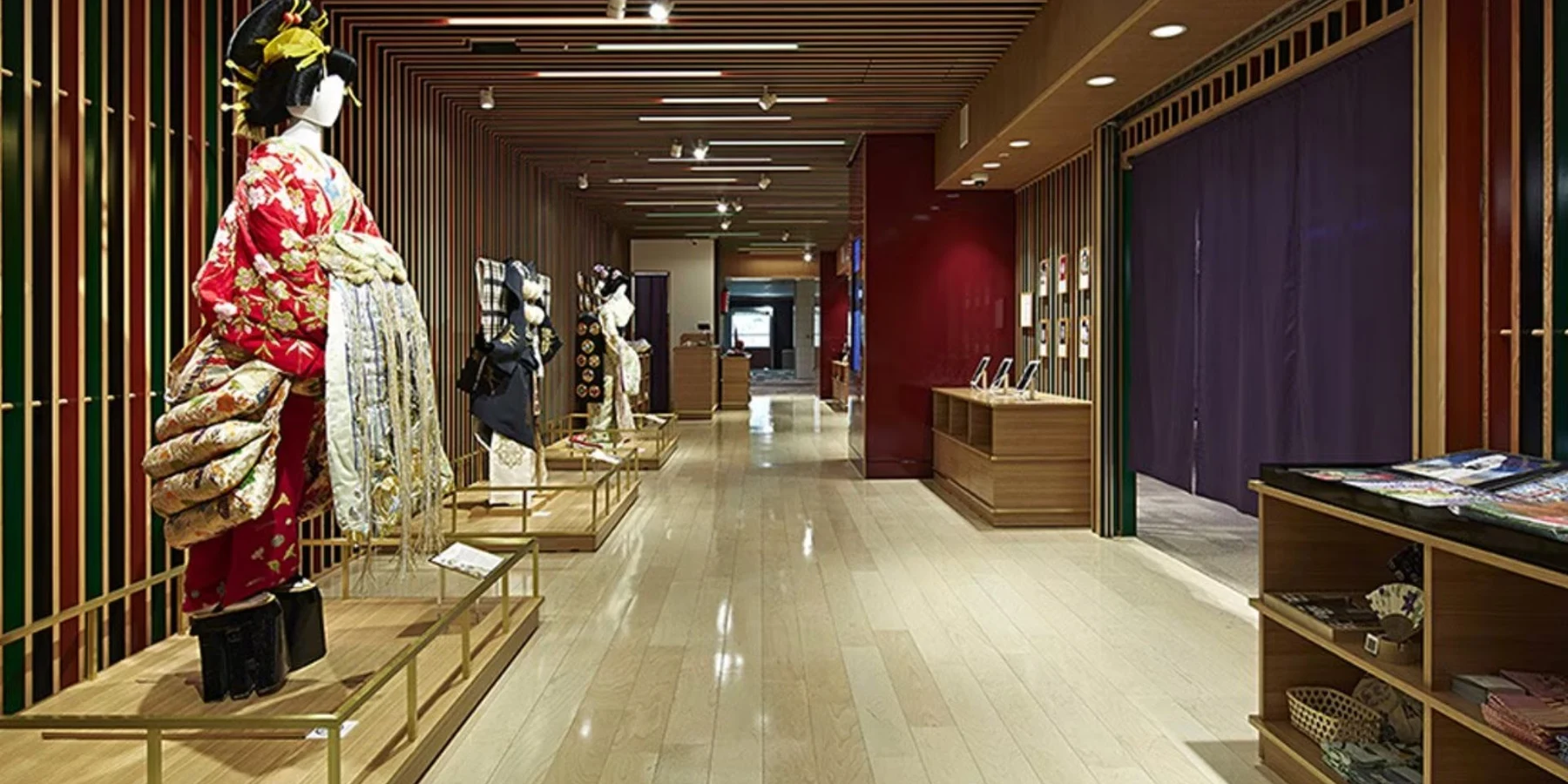
Terminal 1's Kabuki Gate sits past security on the fourth floor. The gallery stages authentic costumes from active productions: layered robes, massive swords, elaborate wigs assembled by the same Kyoto craftsmen who dress Tokyo's working kabuki theaters. Specialnormal Inc. designed the space in partnership with Shochiku, the company that produces kabuki in Tokyo, using wooden lattices in the three colors of a kabuki curtain: black, yellowish brown, light green. A tablet station running the Kabuki Face Photo Booth applies kumadori face paint to your reflection; you send the image to your phone before boarding.
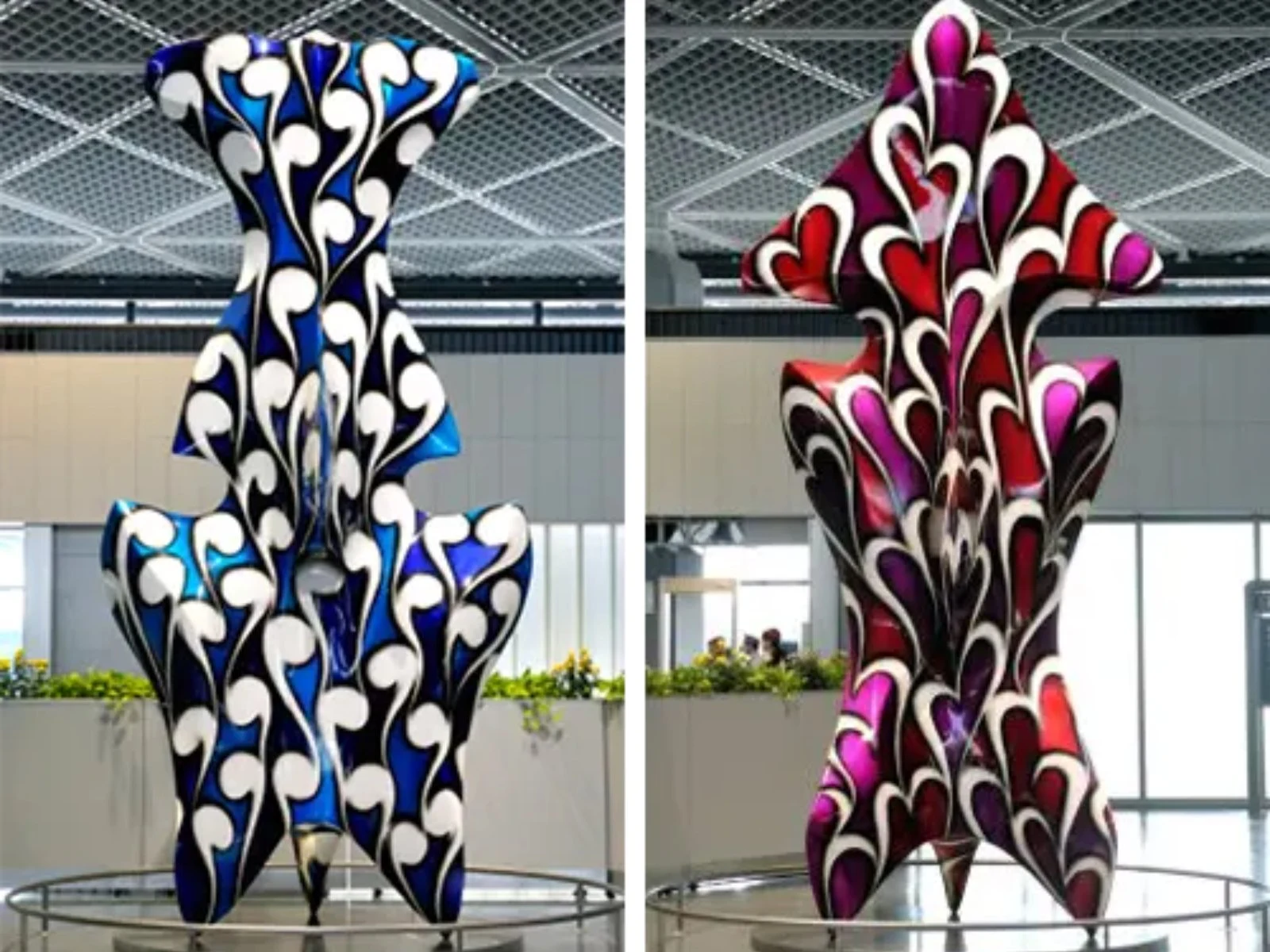
The Art Promenade runs across Terminal 1 without announcement. In the basement of the Central Building, the Tokyo National Museum maintains a permanent mini gallery of rotating works from the museum's collection, displayed at the foot of the escalators before security. Past passport control on the third floor, Masami Takahashi's "Japan/All Things are Connected" covers an entire wall. Commissioned works by Seibo Kitamura and Kiyoshi Awazu hang on the fourth floor. None of them are labeled as a gallery. They are simply there.
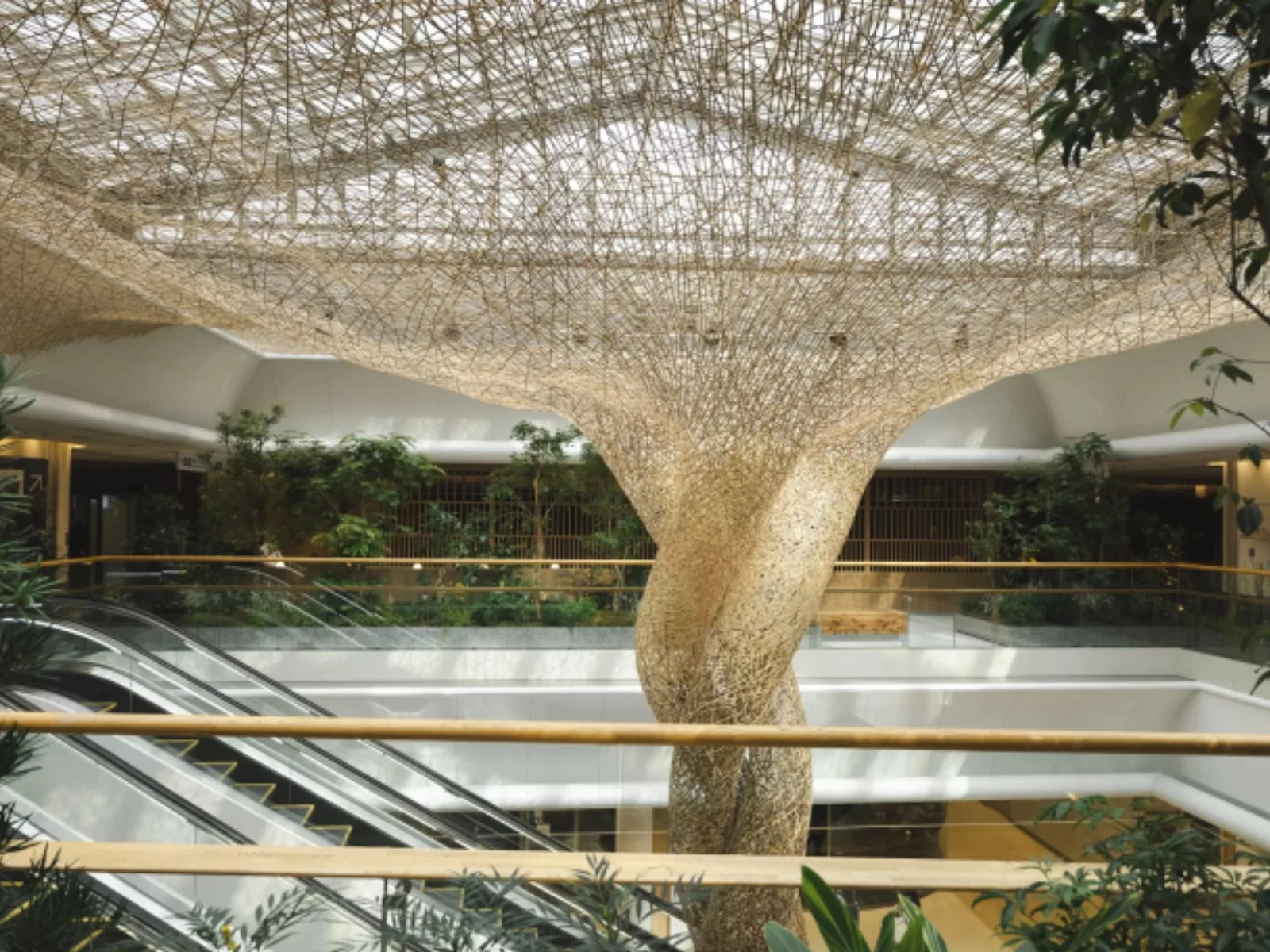
On the fifth floor, SHIKISAI GARDEN opened in April 2026 after a year of renovation. Bamboo artist Tanabe Chikuunsai IV wove approximately 30,000 stems into a single suspended installation called "Ring of Sky," connecting the observation deck to the floors below. A tatami tea room and a calligraphy reading space sit beside it. The renovation cost 2.5 billion yen.
Past security in Terminal 1 and Terminal 2, the airport runs hands-on workshops throughout the year: woodblock printing, carp streamer painting, lantern making. The schedule rotates monthly.
The secret to eating well at Narita is ignoring the business lounge buffets entirely. The best meal costs under five hundred yen and comes wrapped in clear plastic.
Find the Lawson in Terminal 1. There are two: one in the basement, open around the clock, one on the fifth floor. Both are before security, so plan accordingly. Buy a tamago egg salad sandwich on impossibly soft milk bread. The egg is cooked that morning. Grab a grilled salmon onigiri, the rice still warm, the nori still crisp at the fold. A cold Pocari Sweat. Two people eat well for under a thousand yen. The basement location runs twenty-four hours and is where you go at five in the morning when nothing else is open.
For the serious version, Ginza Kagari in Terminal 2 on the second floor airside has been Japan's leading name in toripaitan ramen since its Ginza flagship opened in 2013. The bowl is chicken paitan: dense white broth, clean and rich, with truffle soba. The original Ginza location has international recognition and a permanent queue. At Narita the wait is shorter and the bowl is the same.
For something hot before a red-eye, Ippudo in Terminal 1 Central Building on the third floor airside serves tonkotsu ramen from a recipe running since 1985 in Fukuoka. Rich broth, firm noodles, shiromaru or akamaru. The brand runs restaurants across Japan and in twenty countries. The Narita version is five hundred metres from your gate.
For coffee, find Kanno Coffee in Terminal 2 past security on the second floor. It is a kissaten, not a chain. Skip the Starbucks.
Here is what the seasoned Narita traveller knows that you do not.
First: luggage delivery. Find the Yamato Transport counter in the arrivals hall of Terminal 1 or Terminal 2. For roughly two thousand five hundred yen per bag, they will ship your suitcases directly to your hotel in central Tokyo, arriving by evening for morning drop-offs. You walk straight to the train carrying nothing but your passport and a daypack. It works in both directions on departure.
Second: the Kids Parks. Narita has play areas past security in all three terminals: Terminal 1 on the third floor after passport control, Terminal 2 in the connecting corridor and on the second floor after security, Terminal 3 on the third floor after passport control. Children burn energy before the flight. Parents sit beside them and eat a Lawson onigiri in peace.
Third: the observation deck. Terminal 1's SHIKISAI GARDEN on the fifth floor reopened in April 2026 with three footbaths facing the runway, a raised Mountain Deck, and wire fencing spaced for photography. The 747 freighters are Narita's own kind of aviation theater. NCA, FedEx, UPS, still running cargo routes that most airports retired. Four engines. The hump. Living history on an active runway.
Narita has thought carefully about what a long connection costs you physically, and built answers to each problem.
Nine Hours is in Terminal 2, before security on the basement floor of the car park building. Capsules by the hour: ¥1,500 for the first hour, ¥500 per hour after that. Shower included for guests, ¥1,000 separately if that is all you need. The front desk runs around the clock. For a private room with a proper bed past security, the airport's own nap rooms in Terminal 1 on the third floor and Terminal 2 Satellite on the third floor take connecting passengers without immigration, with single rooms from ¥3,000 per hour. For something between a capsule and a room, Airport Café NODOKA in Terminal 2 on the second floor is open twenty-four hours: free drinks, private booths, a lawn area, showers. It costs nothing to sit down.
Traveling with a family on a long connection: the Kids Parks across all three terminals handle the first two hours. They are past security in Terminal 1 and Terminal 2, and on the third floor of Terminal 3. Children burn energy. Parents sit beside them and eat a Lawson onigiri in peace.
For the business traveller, the JAL and ANA lounges at Terminal 2 open before the first departure. Both are past security, accessible on oneworld and Star Alliance business class and status.
You have two hours. Or four. Or eight. Or thirteen. Here is what to do.
Stay airside. Kabuki Gate in T1. Lawson sandwich before security. SHIKISAI GARDEN observation deck if time allows.
Sushi Kyotatsu in T1 or T2. Nine Hours pod for ninety minutes. Yoshinoya before boarding if the hunger returns.
Skyliner to Ueno: forty-one minutes. Senso-ji before the crowds. Subway to Asakusa. Street food at Ameyoko market. Skyliner back with an hour spare.
Narita Express to Tokyo Station: fifty-three minutes. Imperial Palace gardens. Sushi counter lunch in Marunouchi. Akihabara in the afternoon. Express back. Nine Hours pod before boarding.
The Narita Express runs to Tokyo Station in fifty-three minutes, stopping at Shinjuku and Shibuya on the outer loop. The Skyliner to Ueno takes forty-one minutes with no stops. Both run every thirty minutes. A taxi from Narita to central Tokyo costs around twenty thousand yen and takes sixty to ninety minutes depending on traffic. It is never the right answer. The N'EX round-trip ticket bought at the airport costs forty-seven hundred yen and includes a preloaded Suica card valid on every subway, train, and bus in the city. Buy it before you leave the arrivals hall.
Narita's photograph is on the Terminal 1 rooftop observation deck at dusk.
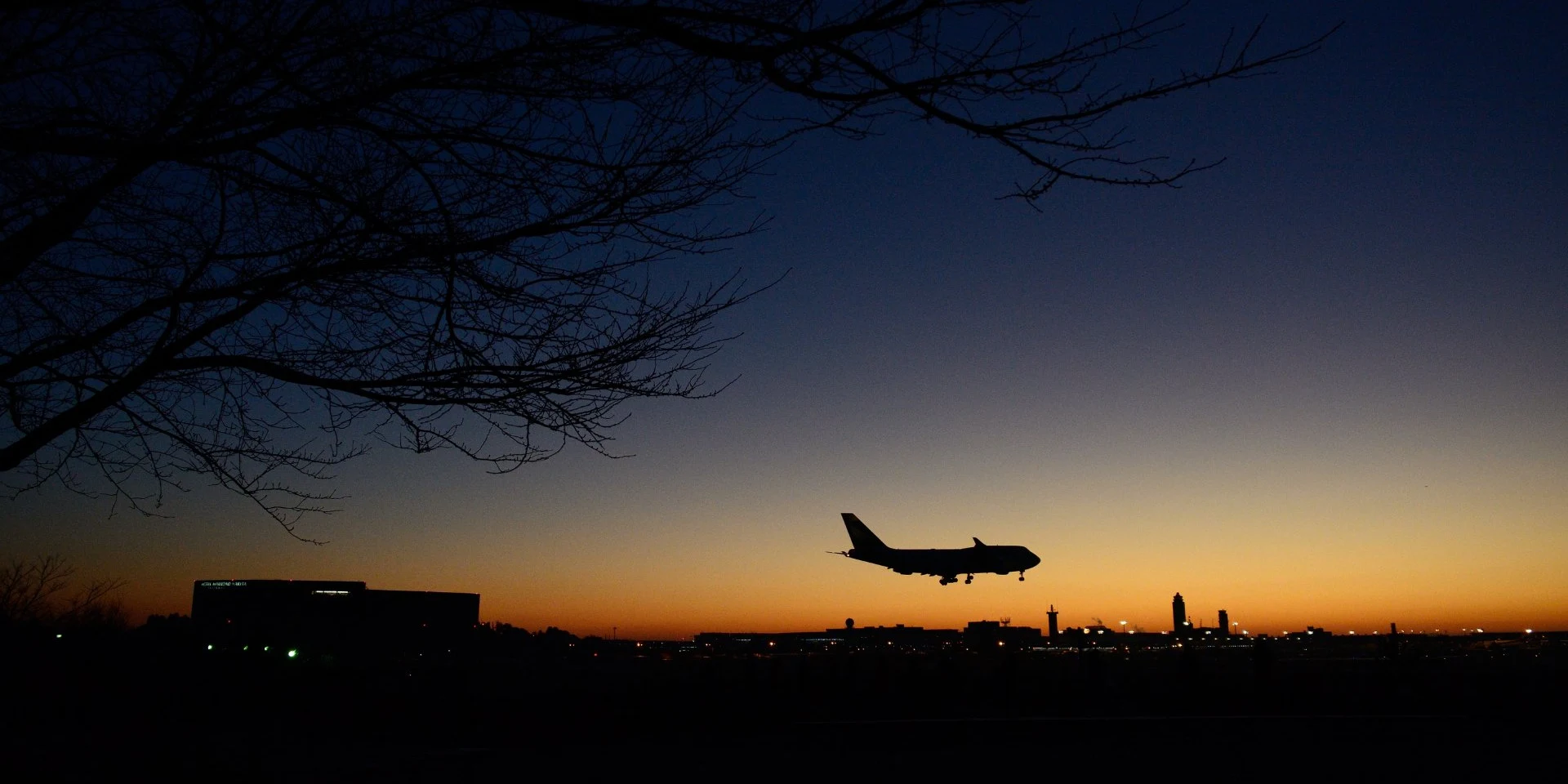
The 747 freighter is the specific frame. FedEx, UPS, Nippon Cargo. The big freighters that have largely disappeared from other major airports still run Narita routes in volume. Position yourself at the western rail with the runway threshold below and wait. When the nose of a 747 lifts past the deck edge, switch to 0.5x. The wingspan fills the frame. The four engine pods, the distinctive hump, the landing lights still burning in the evening sky.
The effect is of the postcard of Japan, distilled into an airport floor. An aircraft leaving, a mountain sometimes visible in winter to the west, the oldest symbol and the newest machine in a single frame. On the day the light is right and a 747 rotates into it, it is unforgettable.