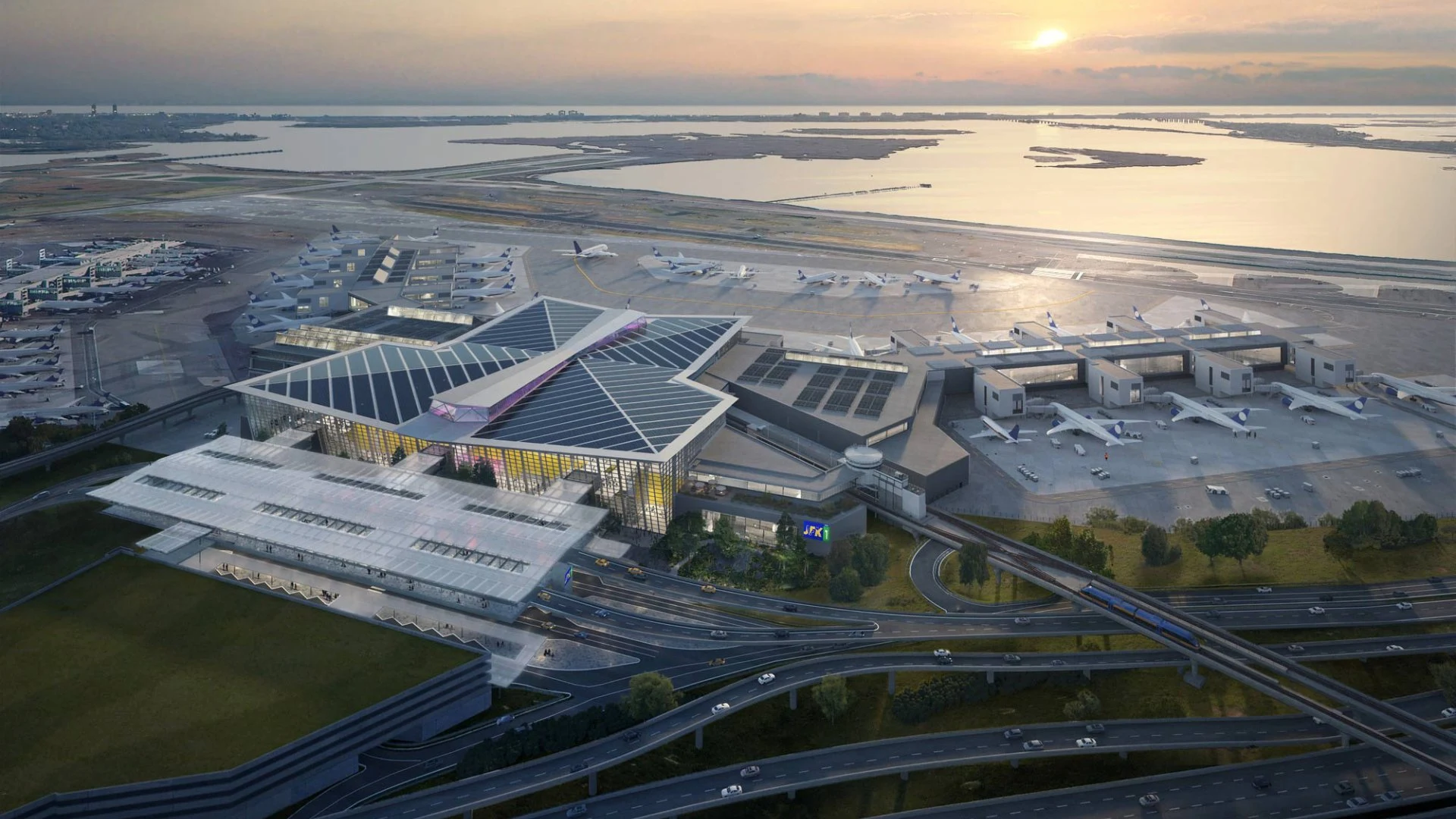
There is a reason every immigrant, every returning soldier, every first-time visitor to America has stepped off a plane and into the same overheated arrivals hall. JFK is not the world's most efficient airport. It is not the most beautiful. It is the one that matters most. More people arrive into America through these terminals than through any other door on the continent. This is where the brave new world begins.
It was built on marshland in Queens, carved out of Jamaica Bay because New York needed an airport worthy of what it was becoming. The jet age launched from here in 1958 when a Pan Am 707 lifted off for Paris. In 1970 the world's first commercial 747 departed from this runway. JFK did not witness aviation history. It kept producing it.
Five terminals. Nearly a hundred airlines. Nonstop flights to every inhabited continent. The airport carries the name of a president assassinated in November 1963, renamed on Christmas Eve that same year. Its original IATA code was KIA. The Port Authority changed it in 1968. Some letters you don't put on a boarding pass.
Thirty miles to the southwest, a statue holds a torch over the harbor. She has been watching arrivals for a hundred and forty years. JFK is where the planes land now. The door is the same. If you have time before your connection, stay. Soak in the United States of America. Land of the free.
The whole tired, hopeful world lands here.
No arrival means quite as much.
JFK's signature is a building that should not exist anymore.
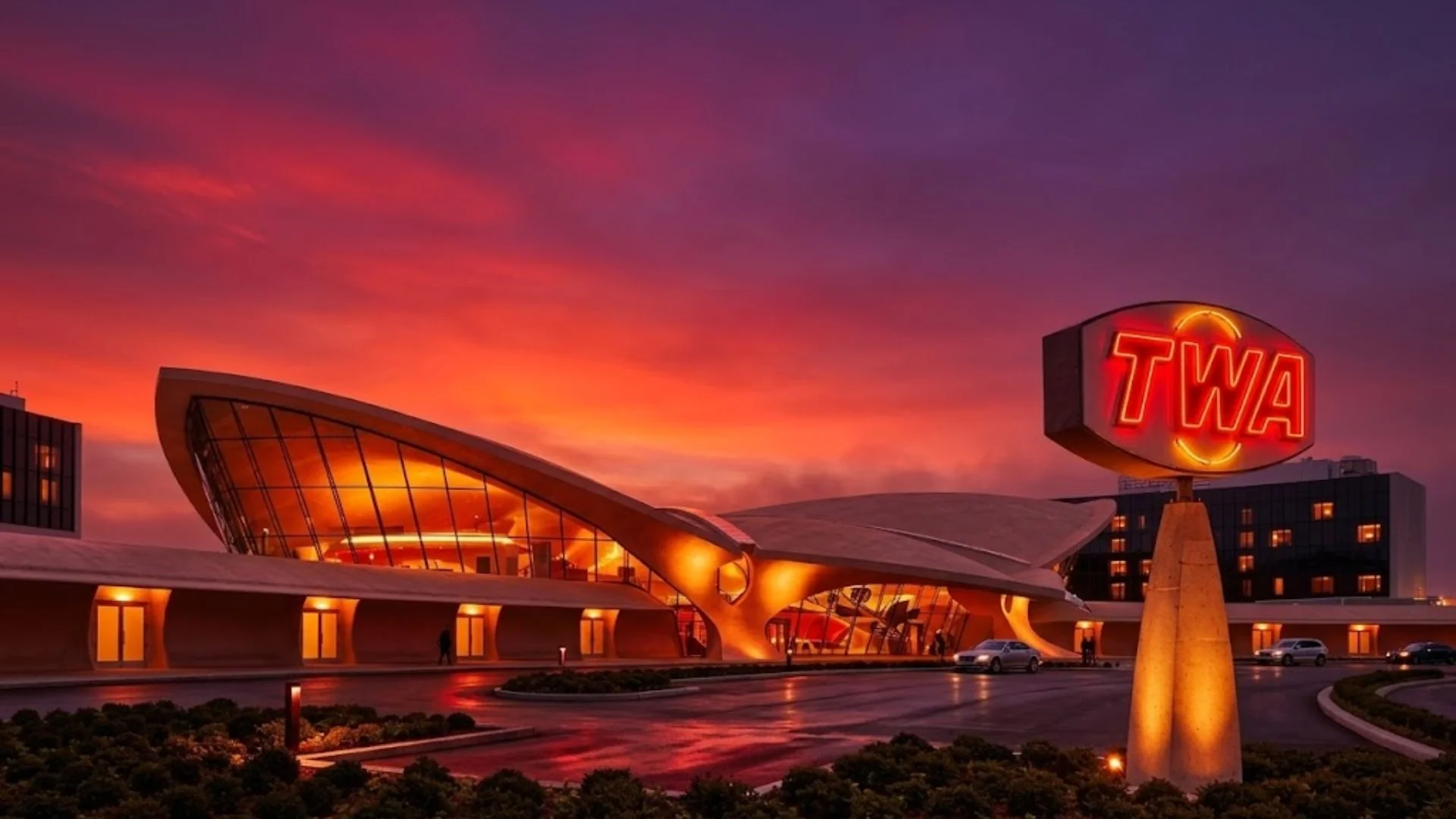
Eero Saarinen completed the TWA Flight Center in 1962. The concrete shell spreads like a bird in full flight — two sweeping vaults, no straight lines, a glass wall facing the tarmac that floods the interior with runway light. Inside: chili-pepper red carpet, penny tile floors, a sunken lounge where crowds once watched the Beatles arrive. A Solari split-flap departure board clicks in the center of the room. TWA went bankrupt in 2001. The terminal closed. For eighteen years it sat abandoned inside an active airport.
In 2019 it reopened as the TWA Hotel. The shell is intact. The curves are intact. The carpet is intact. MCR Development added 512 rooms, a rooftop pool, and six bars, and touched nothing Saarinen built. The golden age of flying did not die. New York put it in a time capsule.
Parked on the tarmac between the hotel lobby and Terminal 5 is a 1958 Lockheed Constellation L-1649A Starliner. One of four left in the world. After retiring from TWA it became an Alaskan bush plane, was sold at auction in 1979 for one hundred and fifty dollars, briefly served as a marijuana airdrop, and spent decades abandoned before MCR Development hauled it three hundred and fifty miles to JFK, with a weekend stop in Times Square. The interior is chili-pepper red carpet, original plaid airline seats, and a bar in the rear galley. You board through the forward hatch and order a martini in the same cabin that once flew passengers from Idlewild to Paris in fourteen hours and fifty minutes. Modern jets taxi fifty feet away.
In Terminal 4, past the security checkpoint, there is a Tiffany and Co. store. It is the only airport Tiffany location in the United States. The blue box. The robin's egg. The most recognizable luxury brand New York has ever produced, available in the most American airport in the world, between your gate and your flight.
In the Terminal 4 arrivals hall, before you clear customs, you walk past "Walking New York" by Deborah Masters. A painted relief eight feet tall and three hundred and fifty feet long. Twenty-eight panels: garment workers, subway riders, basketball courts, Chinatown, construction sites, the 7 train. Every arriving international passenger walks the length of it. Most do not stop. They should.


The secret to eating well at JFK is understanding that the city came to the airport. You do not need to settle for what is in front of you. You find the outpost.
Find H&H Bagels in the Terminal 5 food court, right after security. H&H opened on the Upper West Side in 1972. The original location is gone. This one is not. An everything bagel with scallion cream cheese — hand-rolled, kettle-boiled, golden crust that resists the first bite and gives on the second. Mariah Carey called them sublime. The Seinfeld writers put Kramer on strike at H&H for twelve years. Under fifteen dollars. Open from five in the morning. The most New York thing you can eat before a flight.
For the serious sit-down, the Paris Cafe by Jean-Georges occupies the mezzanine of the TWA Hotel in its original 1962 location. The menu was built around historic TWA in-flight menus. You eat in Saarinen's terminal, under the curves, before or after your flight. Reservations recommended. Walk-ins welcomed.
In Terminal 4 past security near gate B32, Uptown Brasserie by Marcus Samuelsson brings Harlem to the concourse. The menu covers breakfast, lunch, and dinner. The reuben is the move. The salmon with grilled asparagus and warm lemon honey mustard is the alternative if you have time to sit. It is one of the better airport meals available anywhere in the system.
For coffee, find Intelligentsia in the TWA Hotel lobby. It operates from a custom cart built into the 1962 terminal. The beans are sourced, the espresso is pulled properly, and it costs the same as the chain two gates down. Skip everything else.
Here is what the seasoned JFK traveller knows that you do not.
First: the rooftop pool. You do not need a room at the TWA Hotel to swim. A day pass is bookable online — fifty dollars for adults, heated to ninety-five degrees year-round, overlooking Runway 4L. The pool sits above an active runway. In January you sit in steaming water and watch international jets rotate into the sky above Queens, steam rising around you, the sound of engines crossing the perimeter fence. Book in advance. Reservations are required from May through November and sell out.
Second: the luggage drop. Leave your bags with the TWA Hotel bell desk. No room booking required. Take the AirTrain to Jamaica carrying nothing, catch the Long Island Rail Road to Penn Station, spend the day in Manhattan unencumbered. Return, collect, walk to Terminal 5.
Third: the AirTrain calculation. The train is free between terminals and costs $8.25 when you exit at Jamaica or Howard Beach. From Jamaica Station, the Long Island Rail Road reaches Penn Station in around twenty minutes for twelve dollars. JFK to the centre of Midtown Manhattan: under forty minutes, under twenty-five dollars total. Taxis from JFK run sixty dollars and up in good traffic and can take twice as long depending on the Van Wyck. Take the train both ways, every time.
Fourth: the Delta Sky Club Sky Deck in Terminal 4. Two locations, both with a covered outdoor deck and tarmac views. Access requires a Delta One ticket, Sky Club membership, or an eligible Amex card with visits remaining. Fresh air above an active runway before a long-haul flight is not something most airports offer.
New York solves the layover problem the New York way: with a mid-century time capsule connected directly to an active terminal.
The TWA Hotel's Daytripper reservation is the anchor. Book a room by the hour — minimum four hours, from six in the morning to eight at night, starting around one hundred and fifty dollars. Soundproof floor-to-ceiling windows, runway views, rooftop pool access included. You check in, drop your bags, swim, sleep in absolute silence while jets idle outside your window, and walk to security in under ten minutes. The only on-airport hotel at JFK, connected to Terminal 5 via Saarinen's original flight tubes.
Families in Terminal 5 have JetBlue Junior — an aviation-themed play space for children aged two to twelve, open around the clock and unstaffed. A cockpit simulator, a route map game, a reading nook. Children burn energy. Parents sit beside them and eat a bagel in peace.
For the business traveller with time to fill, the TWA Hotel's ten-thousand-square-foot fitness centre is available on a day pass for twenty-five dollars. Peloton room, yoga studio, and a shower before your flight.

You have two hours. Or four. Or eight. Or thirteen. Here is what to do.
AirTrain to Terminal 5. TWA Hotel lobby. Sunken Lounge. Drink at the Connie. Museum. Return through the flight tubes.
AirTrain to Jamaica, LIRR to Penn Station. Walk the High Line from Gansevoort to 34th Street. Chelsea Market below it. Train back.
LIRR to Penn, subway to Brooklyn Bridge. Walk the bridge. DUMBO for coffee. Pizza at Juliana's. Grand Central for the ceiling. Train back.
Central Park to the Met. Lunch in the West Village. High Line at dusk. Top of the Rock at sunset. Train back. Day room at the TWA Hotel before the flight.
AirTrain to Jamaica $8.25, LIRR to Penn Station around twelve dollars, forty minutes total. Taxis run sixty dollars and up. Take the train both ways.
New York's photograph is the Sunken Lounge.
Stand on the mezzanine of the TWA Hotel, looking down at the red carpet and the window wall facing the tarmac. Wait for a few travellers to walk through the frame. Switch to 0.5x. Point so the split-flap board is visible at the top and the chili-pepper seating curves across the bottom.
This is the photograph that stops people. Saarinen designed it in 1962 for a golden age that lasted a decade. TWA went bankrupt. The terminal sat empty for eighteen years. New York put it in a time capsule anyway. You are standing inside it.