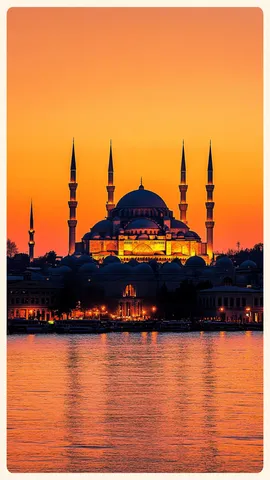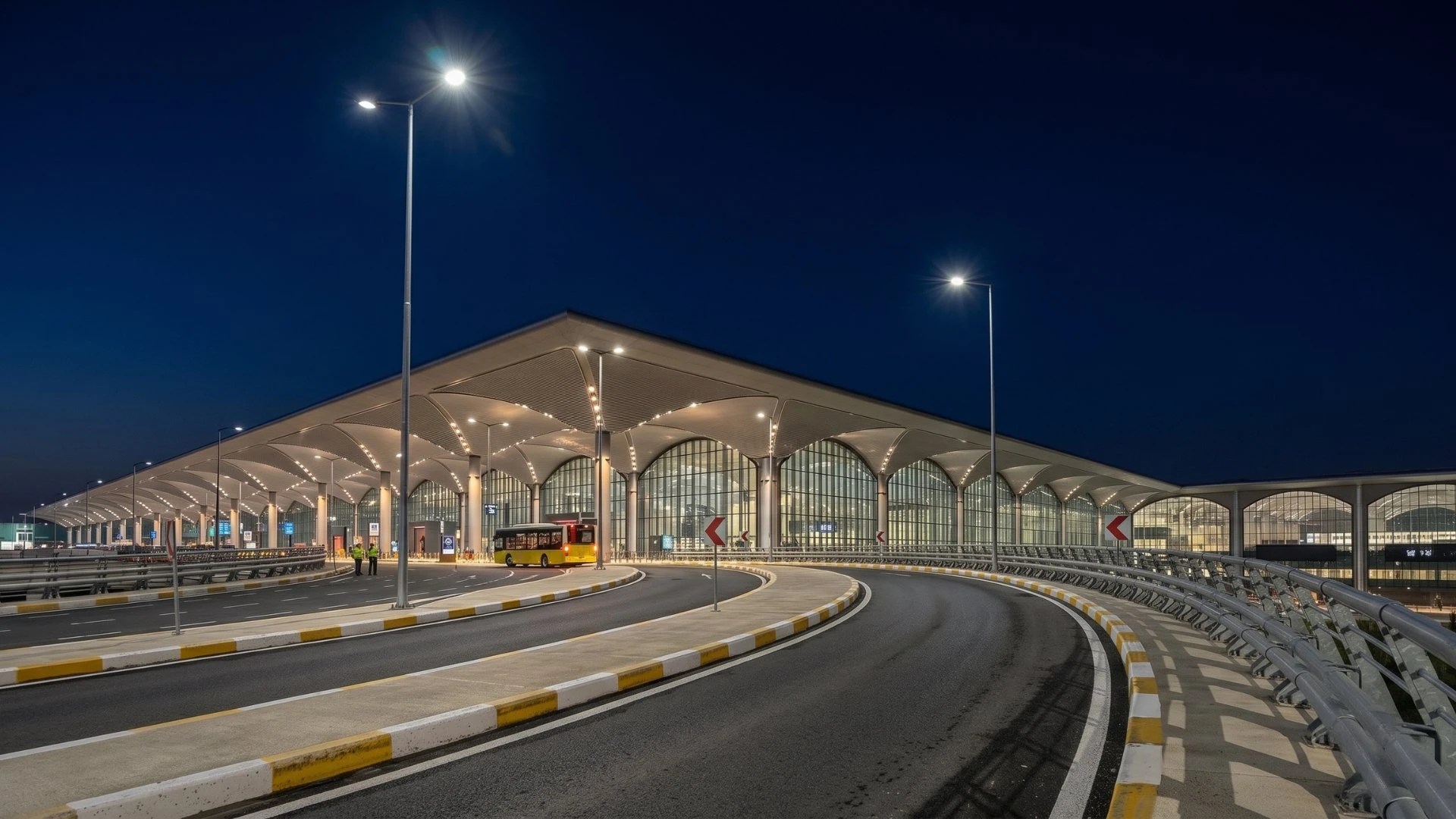
For fifteen hundred years, Istanbul has been the city the world passes through. Romans, Byzantines, Ottomans. The Silk Road. The Crusades. The Grand Tour. Every major east-west movement in human history has touched this bend in the water. In 2019, Turkey built an airport that does not just host this traffic. It inherits it.
Istanbul Airport is the largest single-roof terminal on Earth. One point four million square metres under one continuous vaulted ceiling. Nicholas Grimshaw designed it. The light was modelled on the Süleymaniye Mosque. Walk in and the scale does not announce itself. The ceiling breathes. Skylights drop sunlight in measured columns onto the marble below, exactly where you are standing.
Skytrax grants five stars to only eight hub airports in the world. Istanbul is the newest on that list by decades. The airline that runs it, Turkish Airlines, serves more countries than any carrier on Earth: over three hundred destinations across more than a hundred and thirty nations.
Istanbul treats the layover as the product. Istanbul treats it as the destination. You did not route through Turkey. You arrived at the place where everything routes.
Spanning two continents.
Under one roof.
Istanbul's signature is the art. iGA Art is not the usual airport commission of inoffensive sculpture near baggage claim. It is a full museum programme inside the terminal, with rotating exhibitions by major Turkish artists and loans from the state collection. The airport co-sponsors the Late Fridays programme at Istanbul Modern in the city. A working cultural institution, operating from a concourse.
Step onto the landside observation terrace and look north. Rising from the airfield is the air traffic control tower, shaped like a tulip. Pininfarina, the Italian studio that designs Ferraris, drew the silhouette with AECOM. The tulip is the Ottoman flower. The engineering is Italian. The aircraft below it come from a hundred and thirty countries.
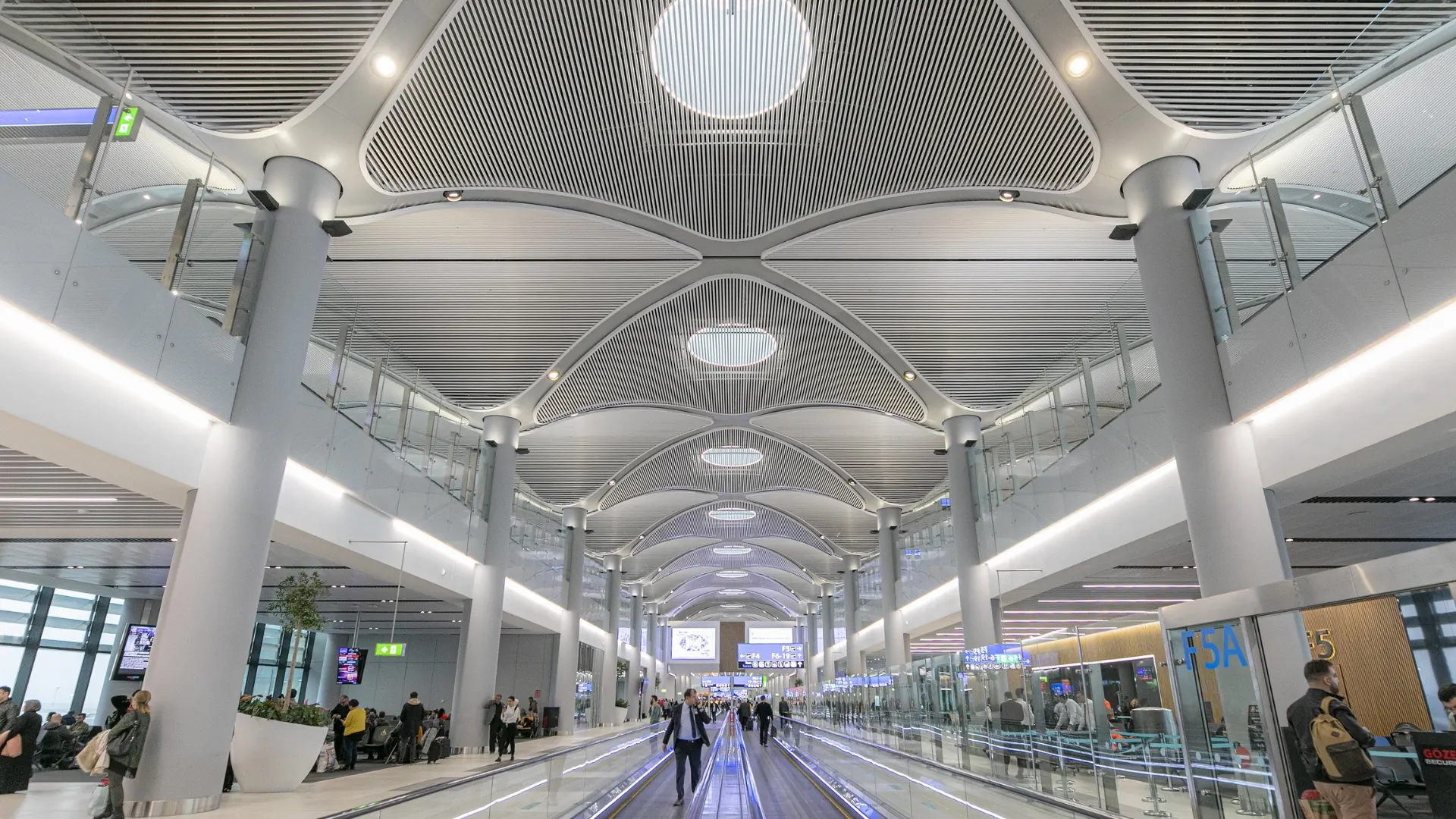
Walk the international departures concourse and it runs for nearly a mile. Do not rush it. The ceiling changes character every hundred metres, vault to dome to flat span, each modulating the light differently. The duty-free is arranged not in corridors but in courtyards, with fountains and olive trees: the Grand Bazaar reimagined at terminal scale.
Inside the duty-free, past the Hermes and the Bulgari, are the things Turkey still makes better than anywhere else. Iznik ceramics painted with the same blue-and-white tulip motifs commissioned by Ottoman sultans. Hand-loomed hammam towels. Cured pastirma and Turkish delight from Haci Bekir, the confectioner founded in 1777. These are not souvenirs. They are the continuation of a civilisation.
At the north end of the international concourse, airside, on the second floor, the Istanbul Airport Museum. A thousand square metres organised by the Turkish Ministry of Culture. Three hundred and sixteen artefacts on rotation from twenty-nine Turkish museums. One of the current items is a replica of the Kadesh Treaty, signed in 1269 BC between Egypt and the Hittites. The world's first recorded peace treaty. Open nine to nine. Most passengers walk straight past the entrance.
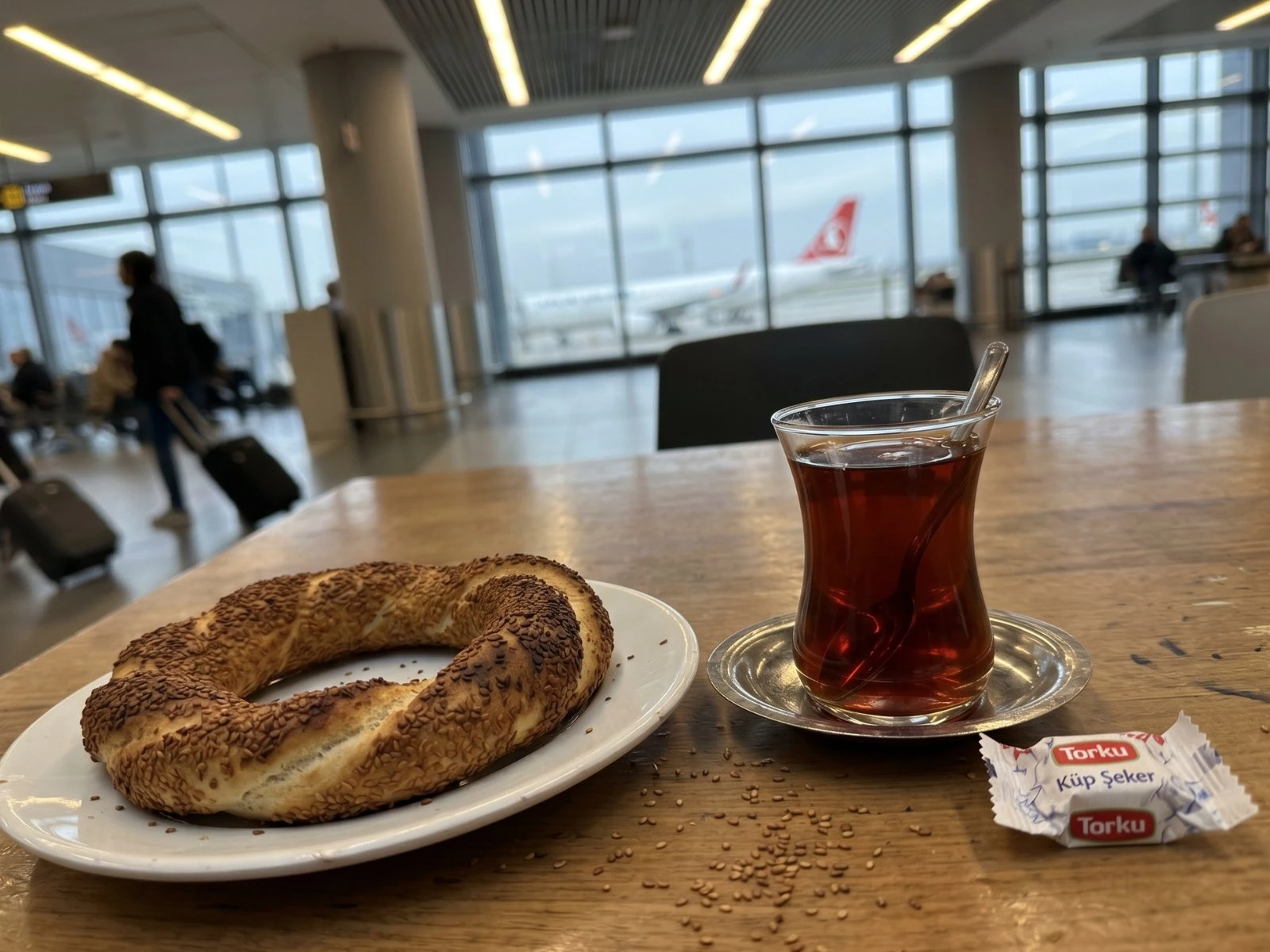
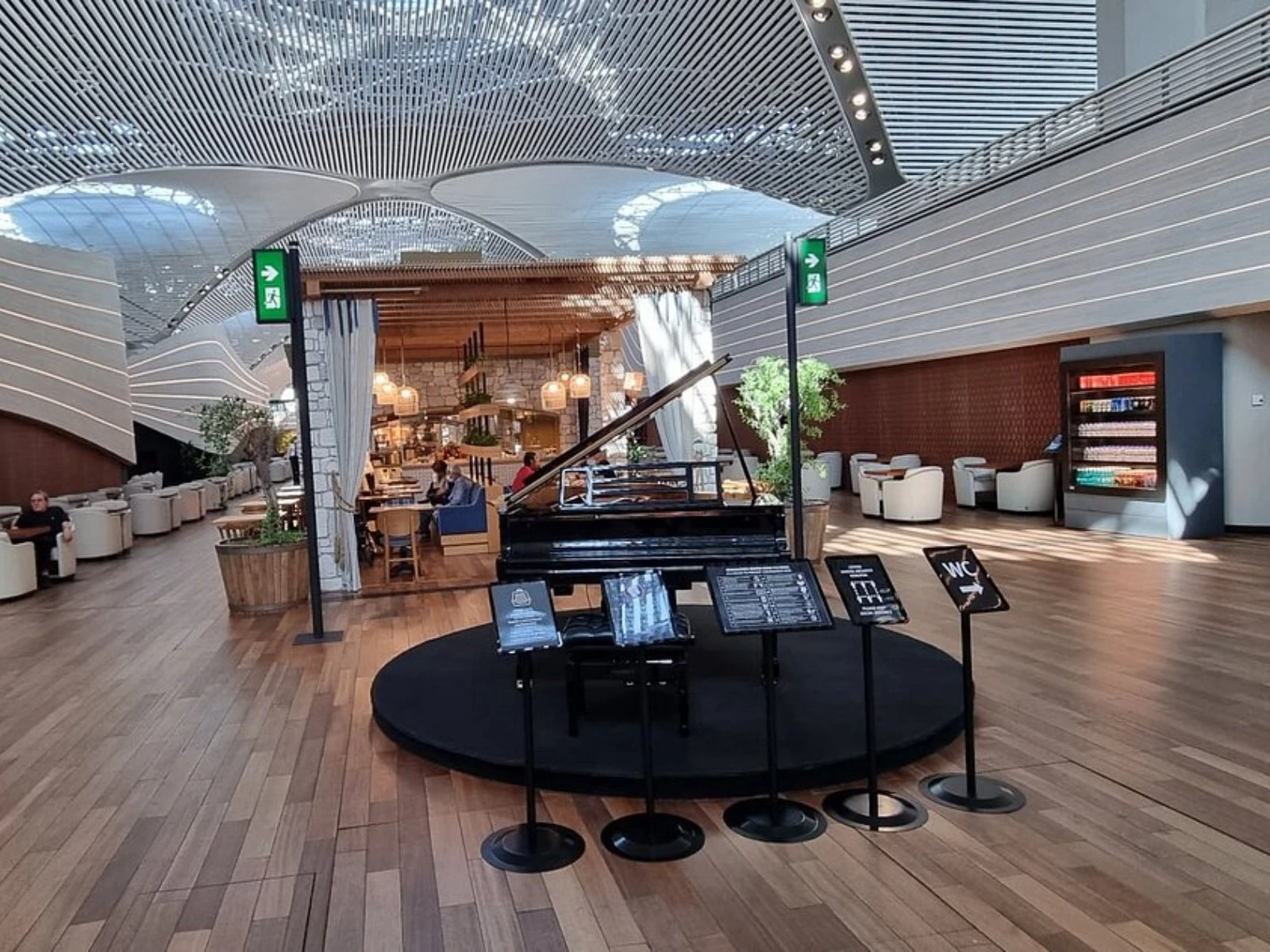
Istanbul Airport won Skytrax's Best Airport Dining award in 2024. It earns the title, but only if you know what to order. The secret is not the international restaurants. It is the Turkish food, eaten the way Turks eat it.
Near the A-B pier, Cuisine Anatolia serves the Anatolian breakfast, the serpme kahvalti. Twelve small plates arrive in a slow procession. White cheese. Black olives cured in mountain salt. Honey from the Black Sea coast. Tahini poured over molasses. Acuka, a paste of roasted tomatoes and walnuts. Sucuk, Turkish sausage, fried in its own fat. A basket of simit and pide still warm from the oven. Eggs to order. Black tea in tulip glasses, refilled until you wave them off. Plan an hour. Order for two.
Near Pier F, Nusr-Et brings its signature burgers, wagyu, truffle fries, and baklava milkshake to the terminal. For something more Turkish and more grounded, Simit Sarayı runs all day across multiple airside locations: freshly baked sesame simit, sandwiches, pastries, and tea. The simit is Turkey's street-food baseline. This is where to find it before boarding. Also near Pier F, Pierre Hermé Paris carries its Ispahan macaron, croissants, and chocolate pastries into the terminal — the world-famous French pastry chef, airside.
One thing to avoid: the international chains, where coffee runs eight pounds and a combo costs three times what it does outside. The Turkish options are better and cheaper in every category.
Turkish coffee is the close. Order sade for plain, orta for medium sweet, sekerli for sweet. Do not ask for milk. It arrives thick and dark in a small white cup, with a piece of Turkish delight on the side. The first cup you have in Turkey. The last cup before you leave.
Here is what the seasoned Istanbul traveller knows that you do not.
First: Touristanbul. If you are flying Turkish Airlines, your ticket number starts with 235, and your layover is between six and twenty-four hours, the airline will take you on a free guided city tour of Istanbul. Seven routes, ranging from three and a half to eleven and a half hours. Hagia Sophia, the Blue Mosque, Topkapi Palace, a Bosphorus view, a meal. Transport and admissions included. The registration desk is in the Arrivals hall near meeting point four. Arrive at the desk at least thirty minutes before departure. No other airline offers anything close to this.
Second: the airport museum. A thousand square metres on the second floor of the international concourse, airside. Three hundred artefacts rotating from twenty-nine Turkish museums. Open nine to nine. Most passengers walk past it. Admission is free.
Third: the YOTEL. Airside, in the transit zone, you rent a cabin by the hour. Private room. Sound-proofed. Hot shower. A real bed. For travellers without lounge access, this is the most effective layover move at Istanbul. A two-hour nap and a shower changes the rest of the journey.
Fourth: the M11 metro. Most people take a taxi and spend fifty euros and ninety minutes in traffic. The M11 opened in 2023, runs from the terminal basement to central Istanbul in forty-five minutes, and costs roughly a fiftieth of the taxi fare. Pick up an Istanbulkart at the metro station. Tap in. Tap out.
Istanbul Airport is built for the long layover. Skytrax named it the World's Most Family-Friendly Airport in 2025, and the distinction is earned. If you know where to stop walking, a twelve-hour wait becomes a twelve-hour reset.
The airport maintains free Nap Zones throughout the international concourse: padded reclined seats in dimmed quiet areas. The cluster near Gate D is the largest and least crowded. No booking, no fee. Prayer rooms and baby care rooms are on every pier. Wi-Fi is unlimited and free for the full duration of your stay.
For families, seven hundred square metres of play zones spread across five themed areas. Gameport gaming zones near the G pier for older children. Free iGA buggy rides for passengers with children under two, through the terminal and all the way to the aircraft door. Baby care rooms with changing tables and warm bottle preparation on every concourse.
The Turkish Airlines Lounge near Gate C is the move: twenty-five thousand square metres of hotel-grade space. A golf simulator, a billiards room, a cinema, a library, private sleep rooms, a pide oven, a gozleme station. Complimentary massage available Tuesday through Sunday. If you have Star Alliance Gold or a Turkish Airlines Business Class ticket, you walk straight in. Nothing else at any airport comes close to this lounge.
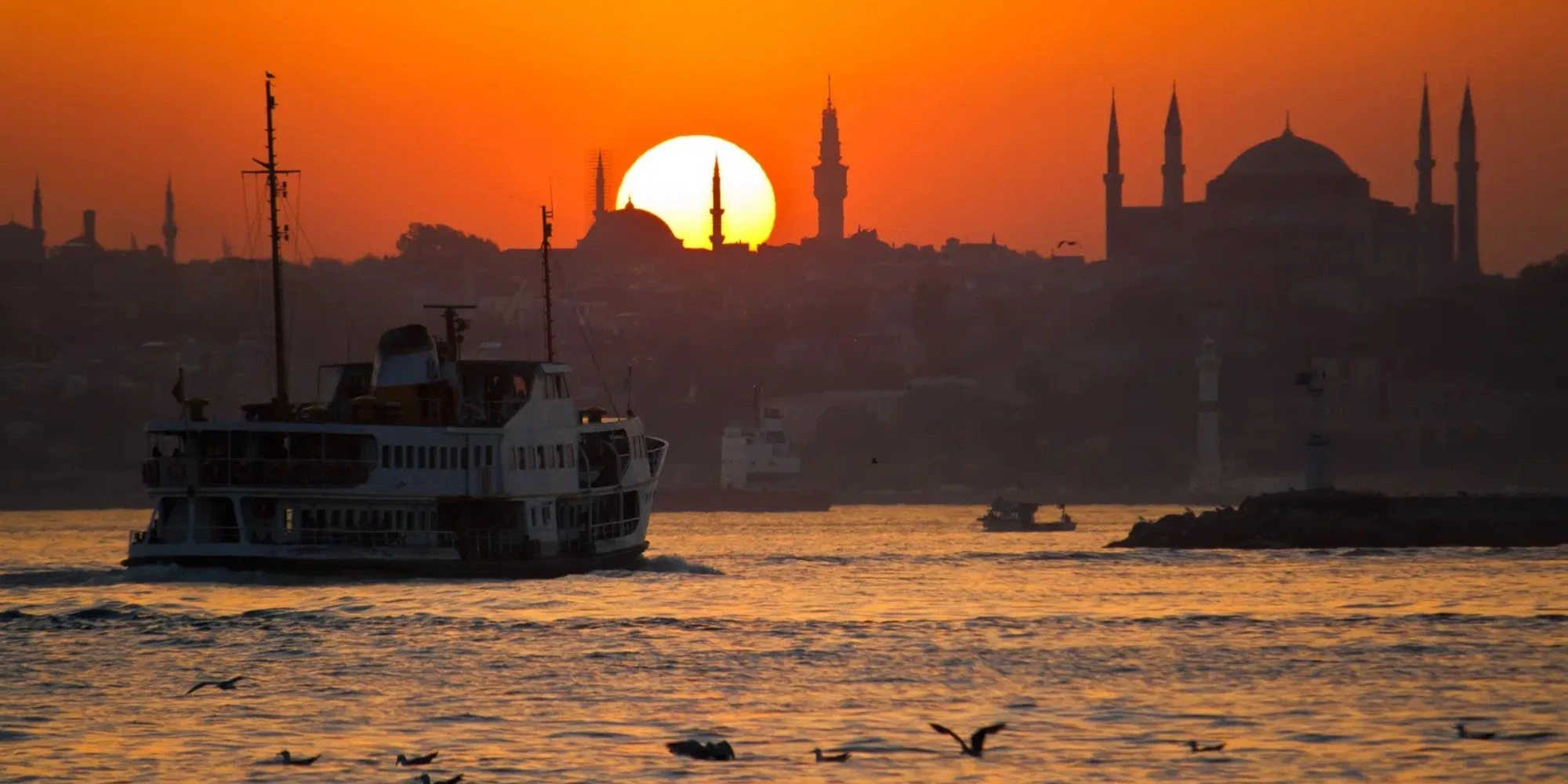
You have two hours. Or four. Or eight. Or thirteen. Here is what to do.
Stay airside. Walk the duty-free courtyards. Eat simit, drink tea. Find the observation terrace and watch the fleet cycle. Turkish coffee on the way back to the gate.
Still airside. Visit the airport museum on the second floor: the Kadesh Treaty, Ottoman kaftans, artefacts from twenty-nine Turkish collections. Two hours inside. One hour on your feet after.
Book Touristanbul. Register at the desk in Arrivals near meeting point four. The Historical Peninsula route covers Hagia Sophia, the Blue Mosque, and Topkapi Palace. Meal included. Back at the gate with an hour to spare.
M11 metro to the city, forty-five minutes. Sultanahmet: the Blue Mosque, the Basilica Cistern. Cross the Galata Bridge at sunset. Balik ekmek at Eminonu. Ferry across the Bosphorus and back. Metro return.
The M11 metro opened in 2023 and is the fastest way to the city: forty-five minutes to central Istanbul, roughly one euro. The Havaist bus runs direct to Taksim in seventy minutes and suits passengers with heavy luggage. Taxis get caught in traffic on the O-7 and are rarely the right answer.
Istanbul's photograph is the ceiling.
Stand near the centre of the international concourse when the sun is high. Look up. The roof rises in a procession of vaulted bays, each pierced with round skylights, each dropping a column of white light onto the marble below. Switch to 0.5x wide angle. Frame the columns of light falling through the full scale of the terminal.
This is the photograph that does not look like an airport. The effect, from the arrivals hall, is of a cathedral that learned to process luggage. Grimshaw said he took the light from the Suleyman Mosque. You take the photograph and you understand exactly what he meant.